What are bridging loans?
Bridging loans, also known as bridging finance, are temporary loans used to fund the acquisition of a new property when you're in the process of selling your current one. They can also finance the construction of a new home while you reside in your present residence. Typically, you'll have a timeframe of 6 months to sell your current property, or up to 12 months if a new property is under construction.
How does a bridging loan work?
A bridging loan helps you buy a new home when you haven't sold your old one yet. The lender pays for the new home and takes over the mortgage on your current home. The total you borrow is called the Peak Debt. It covers what you owe on your old home, the price of the new one, and other costs like taxes and fees.
For a bridging loan, you usually just pay the interest at first. Sometimes, this interest is added to what you owe until you sell your old home.
When you sell your old home, the money you get (after taking away selling costs) goes towards paying off what you owe. The rest becomes the End Debt, which you pay back like a regular mortgage.
Case Study
Let's break down the money part.
Imagine you owe $300,000 on your old house and need $600,000 for a new one. You might be allowed to borrow up to $900,000 in total—this is your Peak Debt.
So, now you have a short-term debt of $900,000, and you have to pay some extra money (interest) on it while you wait to sell your old house.
If you choose to add this extra payment to your debt (if your lender allows), your debt will keep growing until you start paying it back or sell your old house.
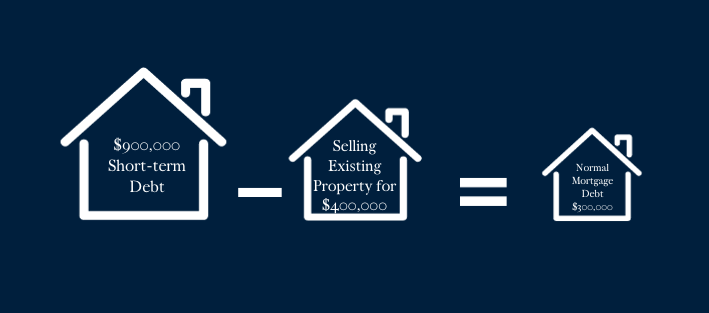
Let's make it easy to understand with numbers. Let's say you've been paying the extra money (interest), and your total debt is still $900,000.
When you sell your old house, you get $400,000 after all the selling expenses. If you use all of that money to pay off your debt, you will have $500,000 left to pay (which is $900,000 minus $400,000).
After this, you just have a regular mortgage, and you pay back a set amount of money at regular intervals.
Here are two big reasons people use bridging loans:
Help with Loan Payments:
If you can't handle paying back loans for both your old and new houses at the same time, a bridging loan can be a lifesaver. It lets you add the extra money (interest) you owe to your total loan. This helps you manage your money while waiting to sell your old house.
Borrowing All You Need:
Sometimes, you want to buy a new house but you don't have all the money for it yet. A bridging loan lets you borrow all the money you need for the new house, plus extra costs. This is great if the house you want costs more than what you'd usually be able to borrow. But, once you sell your old house, you'll be able to handle it.
Paying Back the Money:
When you add the extra money (interest) with a bridging loan, you don't have to pay back a lot in the beginning. It just gets added to your total loan. But it's a good idea to pay some of it back when you can. This way, your total loan won't grow too much. The less you owe, the less extra money (interest) you'll have to pay.
How Do I Qualify for a Bridging Loan? To be eligible for a bridging loan, make sure you:
Have enough value in your old property to secure the loan. You'll pay the interest after selling the property.
Show that you can manage the final debt once you close the bridging loan.
Demonstrate that you can pay the interest during the loan term using savings or other assets.
Your bank will assess the property's value, considering real estate fees, to reduce risk if the property sells for less than the stated price.
Provide a valuation report on your home to prove it has enough value to cover the loan when you sell it.
